



























Why Employees Hate Office Relocation: How To Improve Morale During an Office Move
TL;DR
Office moves don’t fail because of logistics, they fail because of poor communication and lack of employee consideration.
- Employees worry about commute, space, noise, and flexibility
- Uncertainty leads to stress, distrust, and disengagement
- Poorly planned office design can reduce productivity and satisfaction
- Clear communication and employee involvement can dramatically improve outcomes
👉 A successful move isn’t just about where you go, it’s about how you take people with you
The Real Problem with Office Moves
Office moves are often announced like a business update:
“We’re moving offices. More details to follow.”
From a leadership perspective, it’s logical.
From an employee perspective, it raises more questions than answers.
- Will my commute get worse?
- Will I still have a desk?
- Will there be quiet space to focus?
- Is hybrid working changing?
When these questions go unanswered, people don’t wait, they fill in the gaps themselves.
And usually, they assume the worst.

Why Employees React Negatively to Office Moves
1. Uncertainty creates stress and distrust
Workplace change isn’t just operational: it’s personal.
Research from the American Psychological Association shows that employees going through workplace change are more likely to:
- Experience chronic stress
- Trust leadership less
- Consider leaving their organisation
That’s a big deal for something often positioned as a “positive step forward.”
2. The office still matters, but expectations have changed
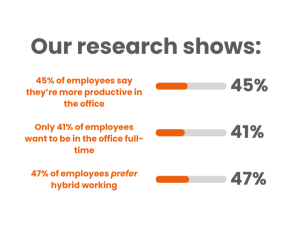
This tells us something important:
👉 Employees aren’t rejecting the office, they’re rejecting offices that don’t work for them.
A move creates anxiety because it puts that balance at risk.
3. Employees and leadership see moves differently
Leadership focuses on:
- Cost
- Efficiency
- Growth
- Space utilisation
Employees focus on:
- Noise levels
- Privacy
- Desk availability
- Meeting space
- Commute time
That gap in perspective is where friction begins.
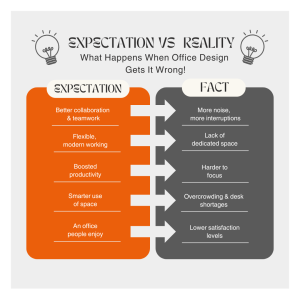
What Happens When Office Design Gets It Wrong
Office moves are often sold as improvements, but that’s not always how they’re experienced.
Studies on workplace design show that poorly planned open offices can:
- Reduce productivity
- Lower satisfaction
- Increase distractions
In fact, one study found that moving to open-plan environments decreased both productivity and satisfaction.
The Biggest Mistake: Poor Communication
This is where most office moves fail.
Not because of logistics.
Not because of cost.
But because of communication.
Here’s what poor communication sounds like:
“We’re moving in June. The new office will support collaboration and growth.”
It sounds polished, but it answers nothing.
Employees want specifics:
- Where is the office?
- What’s changing day-to-day?
- How will teams work?
- What are the trade-offs?
If you don’t answer these questions clearly, trust starts to erode before the move even happens.

What Employees Actually Want from a New Workspace
The good news? Employees are not resistant to change.
In fact:
👉 91% say they could be encouraged to spend more time in the office: if it works better for them
Key drivers include:
- Improved technology (48%)
- Designated desk areas
- Quiet zones for focused work
- Personalised workspaces
How to Build Trust During an Office Move
1. Communicate early and honestly
Don’t wait until everything is finalised. Share what you know, when you know it.
2. Be transparent about trade-offs
If something is changing, say it. Employees will respect honesty more than vague messaging.
3. Involve employees in the process
Research shows that employee participation leads to:
- Higher satisfaction
- Better understanding
- Stronger trust
4. Focus on experience, not just efficiency
A successful move improves how people work: not just how space is used.
Where the Right Partner Makes a Difference
Office moves are complex, but they don’t have to feel chaotic.
With the right support, businesses can:
- Plan moves in phases to reduce disruption
- Use secure storage during transitions
- Design workspaces around real employee needs
- Maintain business continuity throughout
The key is having a partner who understands that a move isn’t just logistical: it’s organisational change.
Handled well, an office move can improve productivity, engagement, and culture.
Handled poorly, it can do the opposite, before anyone even sets foot in the new office.
Thinking about an office move or workspace transformation? Speak to our team to ensure your move supports your people, not just your space.
Frequently Asked Questions (FAQs)
Why do employees dislike office moves?
Because of uncertainty. Employees worry about changes to commute, workspace, privacy, and flexibility, especially when communication is limited.
How can businesses reduce resistance to office moves?
By communicating clearly, involving employees early, and designing workspaces that reflect how people actually work.
Do office moves affect productivity?
Yes, especially if poorly planned. Disruption, unclear communication, and ineffective design can reduce productivity in the short and long term.
What role does storage play in office moves?
Storage provides flexibility. It allows businesses to move in phases, manage refurbishments, and reduce clutter during transitions.
How can companies maintain trust during workplace change?
Transparency is key. Sharing details early, acknowledging trade-offs, and involving employees builds trust throughout the process.
Related stories

Poorly planned moves or workspace transitions can lead to downtime, lost productivity, and unnecessary stress for both leadership teams and employees. Read our full blog to find out more!

The circular economy is centered around designing out waste and pollution, keeping resources in use for as long as possible and regenerating our natural systems. But how do we translate that to create a ‘circular workplace’? And what does that look and feel like?

How to spot under performing space: Office space is one of the biggest investments most businesses make, yet many workplaces aren’t delivering full value.